Thursday, 22 May 2014

End of term


So, the school term is almost over! No more crazy children being cheeky and hilarious, frustrating, infuriating and generally just pretty amazing. No more huge smiles, love notes, hugs from tiny children, over dramatic screaming matches, fights over sharpeners, singing, laughing, chasing and playing. I'm going to miss teaching a lot.

Teaching art has been amazing. I love seeing the kids learn new things, work out problems, and just letting them having a space and opportunity to have some practical fun in a system which otherwise does not really encourage creativeness.
After a few failed lessons of portraiture and still life I quickly realised that doing more 'academic' art wasn't going to stick with these kids. They don't have the patience or attention spans to listen to me explain how to draw a grid for portraiture let alone do it. They are however extremely practical. These children have lived their lives fixing things, working and playing outside all the time, making toys, fixing pushbikes and motorbikes, cooking and cleaning. So while they may not be able to sit in a classroom and listen quietly for an hour they are quite able to fix a punctured tyre on a motorbike, replace a spark plug, cook a meal for their family or help their Dad bring in the plantain harvest. So, after realising this I started to steer my lessons towards more practical making things.

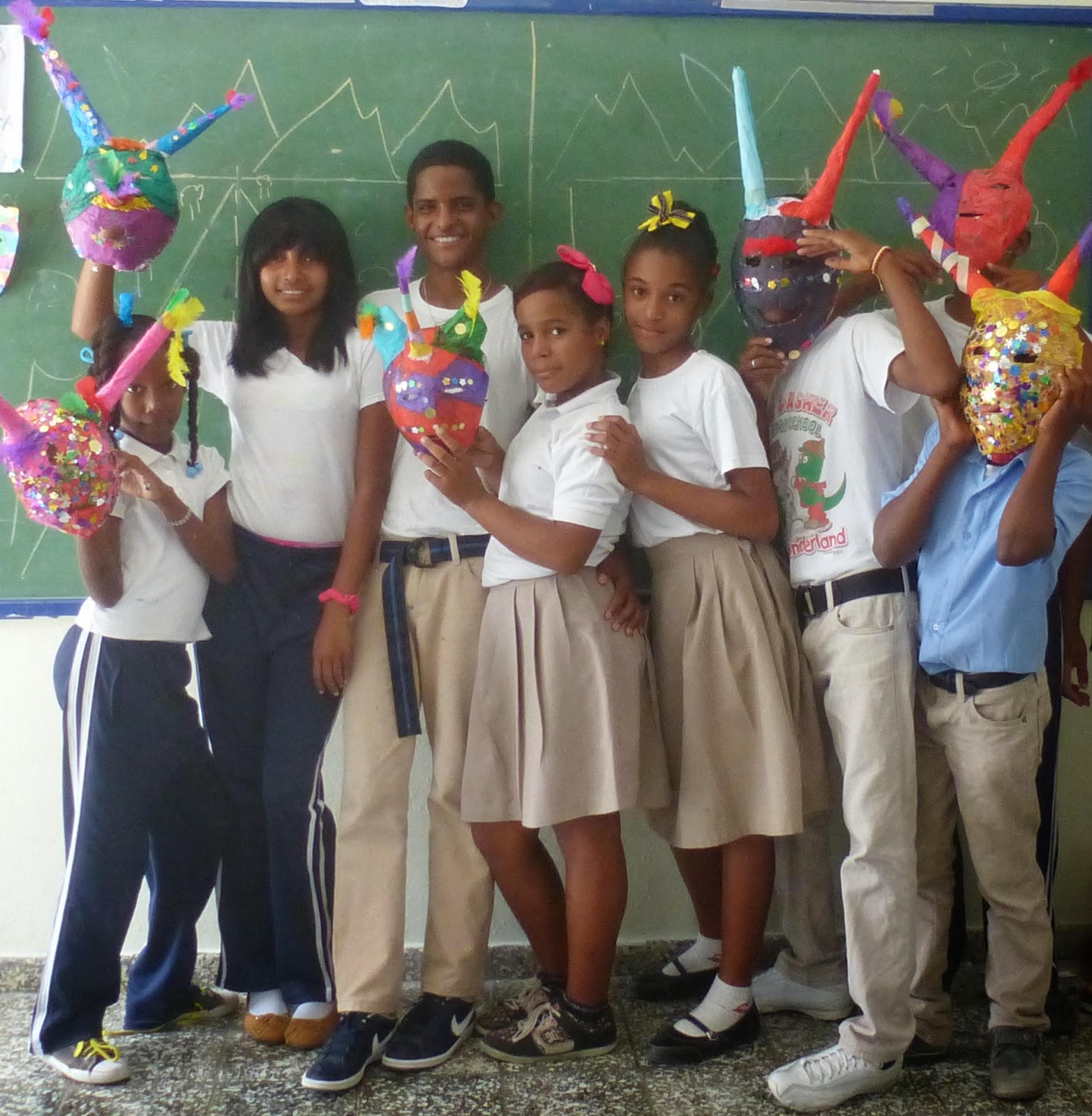
The best example of this was 7th and 8th grades final projects which were paper maché carnival-inspired masks.
The idea came about because I was trying to devise a way of me using up the mound of scrap paper that was steadily gaining mass as the weeks went on. After months of kids coming in and asking to draw something with such desperation you'd think someone was holding a machete to their back then after five minutes of concentration they loose interest and wander out leaving me with a half drawn flower or action hero, I had accumulated a very large stack of scrap paper.

To begin with I got them to work in pairs to cover a balloon with layers of paper using PVA. It worked fairly well and after at least three gallons of glue, a few hundred sheets of paper, and after a lot of breaking up of (mostly) good humoured glue fights I had a few dozen large, dripping white balloon eggs hanging from the drying line. The next challenge was to steer other classes (especially the dreaded fourth grade) away from using the half dry, gluey balloons as punching bags or volleyballs.

Once they were dry we cut each one in half so each person got half a shell. After cutting out the eyes and mouths we then moved onto the more challenging and exiting construction of horns and noses. To make the horns and noses I taught them how to roll up a sheet of paper into a point and use strips of paper to stick it onto the main body of the mask.

Tissue paper was next. By this point in the process thirty percent of the kids had lost interest and either given up on their masks or resorted to chucking what ever colour of tissue paper happened to be within grabbing distance at their constructions and each other. However having the odd non-tryer makes the more successful ones even better and I am now left with lots of beautiful, neat, well thought out and inventive masks staring down at me from the walls.

I love it when children come in out of school specifically to finish a part of their work or to ask for help, and during this topic my classroom was busy every afternoon with morning kids coming in to work on their masks. Now that they are all finished there is a steady stream of kids coming in to ask when they can take them home.

I still can't believe that we have almost finished teaching. I will miss the daily morning unenthusiastic mumbling of the national anthem, I’ll miss walking through kinder and having about ten tiny children suddenly stuck to my lower leg. I'll miss trying work out how everyone is related and watching how they interact together like a big family. I will miss being part of that family. I'll miss not having personal space and getting random hugs, danced with or picked up half way through lessons. I'll miss the strange half English half Spanish declarations of love from the older boys and the cute drawings from the little ones. Most of all I think I will just miss the banter, the sassy girls, cheeky boys and the creativeness of them all. In short I am just really going to miss being teeeaaacchhherrr.

Morning kids back in the afternoon - not in uniform


Sunday, 11 May 2014

School trip


Every year the school takes a group of roughly 150 students from fifth to eighth grade on a school trip. This year the agenda was a four hour bus ride to the capital (starting at 3am) where we would ride on the metro for an hour. Then on for another couple of hours down to La Romanas at the far eastern tip of the island where we would eat lunch (very important) and see caves which held Taino cave paintings, lots of bats, iguanas, stalagmites and stalactites. Finally, before commencing the long journey home we would go to a museum (which turned out to be in the middle of a golf resort) dedicated to information about the Taino history.

As we waited on the pavement for the bus in the darkness outside school at 3am listening to the sound of the breeze in the banana tree leaves and the distant crowing of cockerels we began to prepare mentally for the day ahead. As excited as we were there was also a slight whisper of apprehension at having to spend the whole day (a lot of which was in a small confined space) with 150 hyped up children.

The bus arrived on time (well Dominican time i.e. half an hour after the agreed arrival time) and we drove to the parque, where there was another guagua waiting along with about a hundred children. Tomás, the teacher in charge whipped out the seating plan and began organising kids into seats. Despite the presence of two decent size buses there were still three children to a double seat which didn’t seem to bother anyone and when we were on the road they promptly cuddled up to each other and went to sleep (amazing!) However, as the sun rose an hour or so later so did the volume inside the bus, by seven o’clock we were half way through a highly violent film and people began to feel sick. Now, we had heard horror stories about car sickness on school trips (most of the children although they can all hang precariously onto the back of a motorbike, aren’t used to riding in buses or cars) and so we had prepared ourselves for sick bags and emergency stops. However, although there were a few vomiters on our bus luckly they were positioned a good few rows behind me and Tomás was always on hand with a bag.
After a prolonged toilet break where EVERYONE needed the loo and EVERYONE needed to buy an apple (something that unbeknown to us, would happen at EVERY possible opportunity) we were back on the bus where this time we had the pleasure of watching a film the total budget of which we agreed to have been roughly 47pesos.

We arrived in Santo Domingo at about nine. The older girls (who had been wearing hair nets up to this point) quickly took them off and used the rearview and wing mirrors to organise themselves as we organised the others into two long lines. Everyone was very quiet and probably a bit apprehensive as we descended into the station. For the majority of the children this would be their first time on a metro train and only a few had ventured to the capital a couple of times in their lives. The Santo Domingo metro is only about five years old and very smooth; despite this they all hung on tightly as we began to move away from the station. We rode to the end of the line and back, a trip which took about forty-five minutes. By the end the novelty had worn off and everyone was fairly relaxed, well, everyone apart from the other passengers who had been forced to squeeze into the back few carriages. When we got back to our original starting place there was a bit of a rush out of the train (the doors might close on yoouu, run) and we proceeded back up through the bowels of the metro to the earths surface where a fair number of children then decided that they needed the baño where by we descended back into the station. After a fairly lengthy toilet stop (there were only two bathrooms) we were off again on the road to La Romana.

The choice of film this time provoked some conflict. The bus driver put on music videos of what looked like the top 20 Dominican artists of 2013 all of who were men and all of who sang fairly explicitly about sex. The next two hours were filled with children singing at the top of their voices about sexy women and money. They were accompanied by their newly appointed choir master, Professor Tomás, at the front of the bus and the bus driver who, as well as singing very passionately also beeped his horn the beat of the music. Although this was fairly hilarious and I didn’t mind one bit I found it odd behaviour to be promoted by a Christian school. A few of the children are fairly devout Christians and aren’t allowed to watch or listen to the music that was being played. As soon as the videos started playing the sixth grade girl in front of me put her head behind the curtain and I gave her my jumper to use as a pillow/noise muffler. The eighth grade girl sitting next to Ruth and the girl opposite me both covered their faces with towels, plugged their music in and sang along very loudly to Christian music. So, this is how we traveled the hours to La Romana blasting music about beautiful bodies, sex and money accompanied by a few lone voices singing about raising your hand to God and Jesus our saviour.

When we arrived at the visitors centre at La Romana it was time for lunch. We made our way to the eating area where every single child whipped out a Tupperware box the size of their head filled with large pieces of chicken and either mashed potatoes or mashed plantano. Their lunches made our brown bread rolls look pitiful. The other teachers, including the head master, didn’t bring lunch, instead they brought empty plastic boxes and proceeded to go round each table stealing bits of food from children’s lunch boxes which didn’t really seem to be a problem as most of the kids had enough to feed an entire family.

After lunch we headed in groups down the slippery steps into the caves. They were pretty spectacular with high vaulted ceilings, towering stalagmites and precarious stalactites. Natural light streamed through pot holes in the roof illuminating the series of pillars each of which must have been at least a hundred meters wide and twice as high. It was like walking through a series of echoing prehistoric cathedrals. On the walls there were clusters of Taino painting. They used a mixture of animal fats, mangrove bark and charcoal to draw symbols representing animals and people. There were a few representations of bats as the Taino people believed bats to be gods and as we walked through the caves there was an ever present fluttering from the bats living in the cave roof. Possibly the most beautiful part was a natural pool with water as still as glass. Above it on the cave roof were hundreds of stalactites of varying sizes. The stalactites above the water reflected on its surface creating a reflection which looked like the birds eye view of a fantasy city. Although the kids were impressed with the caves possibly the most exiting bit was the lift back to the surface. For most of them it was their first time in a lift and although it only went up two levels very slowly it was still pretty exiting!
There was just enough time to go and look at some iguanas that lived around the cave entrance before heading to the bus and driving to our final location.

The third and final stop on the trip was fairly odd. We drove to a museum set in an old, very small hamlet complete with amphitheatre, a stone church and viewing platform from which you could look out on an impressive vista of forest and river. However, to go to the museum we had to drive through a huuuge golf resort. It made me uncomfortable and frankly furious as we drove past mansions with shiny range rovers and BMWs parked at the top of winding drives and neatly tended green gardens. There was so much money hidden behind the tall whitewashed walls. Some of these amazing, wonderful, hilarious children who came on the trip had to pay the $300 (about £6) over a series of weeks because their families couldn’t afford to pay the total cost in one go. Yet, as we drove through these gated communities we passed houses with two or three shiny cars in the drive way, glittering swimming pools and gardeners (all of whom had dark Haitian skin of course) tending the pristine lawns. I, however, seemed to be the only one who was overcome by the galling unfairness of it all, the kids seemed to be oblivious, too concerned with singing along to the music video still blasting from the front.

The day began to take its toll on a few children who started to complain of having sore feet, back, head, arms, fingers and what ever else they could think of so we headed back to the bus and began the long journey home. After a quick burst of very loud out of tune singing they settled own and as  it got dark outside they cuddled up to each other and dozed off. The children are essentially all one big family. One is almost inevitably in some way related to another and if not related by blood they have grown up together in the village their whole lives. They interact, and know and support each other like a family which I think is fairly amazing.

The serenity soon ended when the words 'Pica Pollo' (spicy chicken) were mentioned by Tomás. After the first shop ran out of chicken (a disaster which almost lead to tears for a number of children) we stopped at a big service station and waited for a good thirty minutes while chicken was purchased and bathrooms utilised. By the time the pica pollo fiasco had ended everyone was thoroughly exhausted and for the next four hours my shoulder, lap and hoodie were used as pillows for sleepy heads.

Everyone was exhausted but it had been a really amazing and interesting twenty hours. I love spending time with the kids outside school, seeing how they interact with each other and respond to new circumstances. After a very long and cramped but quite nice four hours we neared La Hoya. As we drove through the villages close to La Hoya children hopped off in ones and twos trotting confidently home into the darkness, empty Tupperware boxes rattling in their backpacks.


Thursday, 24 April 2014

Visitors


The past couple of months have been very busy with what seems like an endless stream of visitors.

Last month Felicity (our Desk Officer from Project Trust) came and stayed with us for a couple of days. Every country that Project Trust send volunteers to has a Desk Officer who is the first port of call if you have any questions or if anything goes wrong. All Desk Officers visit their volunteers in the countries that they are in charge of. The visits are really for them to see how we are doing, check that the project is still valid and that the volunteers are happy and healthy.

Felicity arrived in the DR after her visit to volunteers in Peru bringing with her wise words about our OCN report, advice about secondary projects and completing our Global Citizenship award. It also gave us a chance to catch up on Coll life, hear about other volunteers and ask about life after the Dominican Republic (!!!) We had a very busy few days showing her all around the schools and villages, going out for dinner, walking to the river and chatting to everyone! It was really brilliant having her to stay and we all wished that it could have been for longer. Being so involved in the community, COPA, and just general crazy amazing Dominican life I kind of forget that we are part of Project Trust as well so having Felicity here made us feel all lovely and Project Trusty again.

After a fleeting two days Felicity was on the road again, this time to see the boys in Santiago but not before delivering her parting gifts of much needed packets of mini eggs and fruit pastels!

Next on the guest schedule was the family! We had discussed the possibility of them coming out before I left Scotland and agreed that it would be best to wait until I was out here before deciding definitely if they would come and visit. After a couple of months I decided that I would really like them to come. Obviously one of the reasons was because I wanted to see them but honestly, when you reach the point that I am at now you really don't miss home (well I don't anyway!) The reason I wanted them to come is to show them and share with them a bit of my life so that when I get back they have some idea about what I have been doing for the past twelve months, and having people around me who understand how much I love my life here might help with home sickness when I go back as they would have some idea about what I am missing. So, eight months after I left them at the air port in the UK I travelled to the capital to meet them from the airport here. Everything went fairly smoothly other than their terrifying story of almost not being allowed on to the plane in New York! Anyway, after a night in the capital we headed for Samana, in the north east, where they had their first Gua Gua (minibus busses) experience and heard their first 'Ay mi madre!' and 'Ay Dios!' - very special moments. We went by moto concho (motorbike taxis) to one of the best beaches on the island: white sands, proper grass, blue sea, palm trees and best of all no people! I will definitely be revisiting that one!

After Samana it was time for the real deal. After a four hour bus journey on the Expresso with the compulsory blaring bachata and merengue music and the crazy man at the back who sings and claps to every song we arrived tired and hot in La Hoya. Despite the fact that we walked the back way there was no escaping the shouts of 'Ali, Ali, es su familia!?' …and the confused stares from women sitting in plastic chairs outside their houses as the group of Americanas with rucksacks trudged past.

Since then we have been cooked spaghetti, played dominoes, Jesus showed them round his platano fields, my sister amassed a large queue of admirers, walked to the river, cooked Moro, my dad set up a coffee stand for Sylvia and Christina every morning, mum has helped me fix masks to the wall in the classroom, we have snorkelled, barbequed on the beach, had many an uncomfortable trip in the back of the truck, been to church, admired the Dominican vavavooms. …

It was brilliant to see them all again and to have the chance to show them my life here. I was sad to see them leave but I was even sadder because their departure means that we only have three months left which is soooo scary. I can’t bear thinking about leaving and saying goodbye to everyone! Maybe I’ll just stay here, marry a gorgeous Dominican man, live in bright blue wooden house by the sea, cook rice and have babies. Although I am looking forward to seeing everyone in August and the idea of university, I’m NOT looking forward to wet weather, no merengue or Spanish, no daily proposals of marriage, no craazy children; no playing dominoes with Jesus next door, no Mota shouting over the fence to give us bunches of sweet potatoes and bananas; no motorbikes, no knowing everyone that walks past, no fields of bananas or flip flop wearing. That little blue house by the sea is seeming more and more tempting...


Ruth Fiona & Felicity at the pumping station by the river

Christina and her mother teaching Felicity to cook Dominican spaghetti

 Felicity meeting Anita and Fribel

Christina the school guard brought Dad to my classroom to be introduced to the class!

Family and friends on the way to the beach

Hiking through the banana fields at Polo

Saturday, 8 March 2014

Carnival

Carnival is one of the most celebrated and colourful traditions in the Dominican Republic. There are carnivals all over the country every Sunday in February and it reaches its apex on the final weekend when people and groups travel from all over the country to share and celebrate together in huge, extravagant parades. We (the PT volunteers and two of the COPA staff) headed up to La Vega (a town in the north of the country where the tradition of carnival dates back to the mid 1500s) for the final weekend in February to experience this colourful fiesta.
There is evidence of carnivals being held in the country as early as the mid-1500s. The origins of the tradition are believed to date from the time of Christopher Columbus. Slave owners and Christians would organise parades and marches for slaves so that they could get the ‘wild’ out of their system. In later years the practice of carnival became a way for people to escape from strict religious traditions and by the 1700s the practice of carnival had become a major event in the country. The celebration became yet more extravagant when the Dominican Republic gained independence from Haiti on the 27th of February 1844 which is the reason why February is the most celebrated month in the country. The celebration presents an upside down, back to front world. Men dress as women, animals dominate their farmers and (in a country which is by its constitution Catholic) the devil is the king of the carnival.
One of the most spectacular things about carnival is the amazingly extravagant costumes that the performers wear. Lots of regions in the Dominican Republic have their own take on carnival costumes and different visual interpretations of the characters that feature in the celebration. The result of this is a fairly amazing spectacle where everybody comes together to show off and share in this colourful, crazy tradition.
The main character in the carnival is ‘Diablo Conjuelo’ or ‘Limping Devil’. The story of the Limping Devil is that he was banished to earth as punishment for his childish pranks. When he hit the earth he broke his leg and has had a limp ever since. While there are many different theatrical takes on the appearance of the Limping Devil there are some similarities in all the costumes. The most important is the huge, extravagant mask that is an iconic symbol of the celebration and which is often adorned with huge horns, feathers, sequins silks and satins. Many costumes are made up of layers of brilliant material and are embroidered with tiny mirrors and bells with make the wearer sparkle in the brilliant sun. All the Devils at the carnival are equipped with a ‘vejiga’ (balloon) which traditionally was made from an animal bladder filled with air. The purpose of these vejigas is to whack unsuspecting spectators or other devils on the bottom! Whilst the animal bladders have now been replaced by large polystyrene balls, the result is just as sore and we all came away with slightly bruised posteriors!
In addition to the character of Diablo Conjuelo and others from Taino folk law, there are characters that portray different  eras of Dominican history. We saw performers painted with mud and white paint and dressed in loin cloths who represented traditional tribal Taino people who were the indigenous inhabitants of the island. The tradition has become a way of poking fun at various aspects of Dominican history and those groups who so spectacularly mishandled the island and its people. There were Spanish colonialists dressed in pompous tail coats, tights and silken waist coats. There were monks who represent the original Christians on the island who tried to brutally introduce religion to the new world and who, along with the Spanish colonists effectively wiped out the native Taino culture.

Seeing different stages of Dominican history made me realise how young the country really is. Many people say that other than carnival the Dominican Republic doesn’t have many traditions and there isn’t the same sense of culture that you find in places like Peru or even Scotland. There is no national dress or dance, people speak the language of the colonialists and aspire to look and act like ‘Americanos’. However you have to remember that the country hasn’t had the hundreds of years that a country such as Briton has had to develop a national identity. After being taken over by Columbus the DR changed hands from Spain to France and even the British had a go at ruling the place before being pushed out by the French. After finally gaining independence from Haiti in 1844 the country then endured a succession of terrible leaders the most infamous being Trujillo whose dictatorship was endured between 1930 and 1961. On top of all that turbulence there has been the ever present meddling of western powers, most prominently America, whose tactless military and political interferences has put the country off kilter on numerous occasions during the past hundred years or so (good to see that they have learned from their mistakes and have become the level headed rational global power that they are today…!).


Taking into account this turbulent history, the fact that this country has managed to maintain any sense of raw cultural identity and tradition is pretty amazing. This is a celebration of their history and a way of poking fun at the people who have expropriated their country. It’s a way for people to come together, celebrate and be crazy (well crazier that they are normally!). It’s a way for people to embrace their history to learn from it and to grow and develop into a country which is finally free from turbulence.